This is the third book I have read by Lahiri, and probably the best. She tells another in depth story of her people, but this one spans about 50 years and starts in India in a suburb of Calcutta. The boys play in the field across the lowland (of the title), an area that floods during the rainy season. We get a sense of life there, the boys go to school, eventually attend local colleges. Udayan sees the inequities of the world and becomes a revolutionary. Subhash becomes an environmental chemist and goes to America for grad school. Udayan marries Gauri, a philosophy major. Udayan dies early in the book and Subhash comes back to India and rescues pregnant Gauri from his parents by marrying her and bringing her back to Rhode Island.
There are many layers to this book that I enjoyed. As usual, I enjoyed learning about another culture, another historical period. I knew nothing of the student uprisings in India and may want to look into these more. The emigrant experience is always dear to me - the not quite fitting, the accent, the food, but also the wish to stay in America. Then the complexity of families - both what is expected of Indian families and then what happens to the family in the U.S. I also liked the act that libraries and academia played an important role in this story.
The tale was told by the various characters of different generations, not necessarily chronologically, as memories brought us back to the past, filling in gaps of our understanding. Even Udayan has a voice at the very end.
I
have a new state to explore. The only thing I remember about Rhode
Island is visiting my freshman roommate's family in Newport and driving
through it to Boston. It is a very New Englandish state and I forgot how
much it is exposed to the ocean. I may take a loop around it when I attend a conference in CT next year.
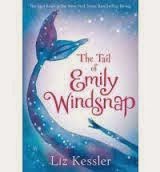
I was looking for a young adult book to send to a relative in overseas and came across this in the best sellers for younger readers. Felt I had to read it before I sent it. I like books that combine today's world with magic or fantasy, and this one combines it with the mythical world of mermaids and mermen. I got a bit critical in my mind about the way some practicalities were treated, like writing and speaking under water, but if I let that go, it was a pretty good story of a girl looking for answers and finding herself. I am wondering if there are too many America focused references, but that may be OK too.
Emily lives with her mother on a houseboat. She doesn't have too many friends and has never learned to swim, but now wants to take swimming lessons. I don't think I will be giving too much away, when I say that once she hits water, she becomes a mermaid and she of course has to explore this new ability. She makes friends with a mermaid her own age - Shona. Besides a doting mother, who doesn't want to talk about her father, we also have the mystic Millie and the sinister lighthouse keeper Mr. Beeston. I love water myself, so I liked all the images of underwater. Hope my relative likes this.
Cultures of the World series. I had our children's book specialist order various children's books on
countries around the world, as our ESL students sometimes have to write about their own cultures for their classes, and we had very little in simple language. I am having some Saudi students over for a dinner during the holidays, and when I saw that this book had come in, I decided to read it, so I do not make some great mistakes while hosting them.
It is embarrassing to say how little I knew about Saudi Arabia. I knew where it was and that much of it was desert, but there is much more variety in this large country. There is dessert, mountains, the big port city Jeddah on the Red Sea, and then the oil is on the east side and gets distributed to the world through the Persian Gulf. Of course the sacred Islamic cities of Mecca and Median are also there, in the western part.
I got a sense of their history and am now curious about Laurence of Arabia. (Let's see if I actually read the books I checked out by him and about him.) I did not realize that present day Saudi Arabia was only established in 1932. I had heard about the royal family, but it is now all in context, in a framework. Women did not get mentioned much and appeared in very few of the photographs. I have read about them elsewhere and am concerned about their status, but I will respect that this book for children was written to not be controversial and not confront Saudi beliefs. It looks like they have been amazingly successful at keeping Western influence to a minimum. The riches they have received from oil go towards the betterment of their society, building, modernizing, without allowing alcohol, immodesty and other things restricted by their religion to enter their social structure. Since women are not to talk to men not in their family, there is no socializing outside of the family, so no restaurants, movie theaters, art galleries. I would definitely like to hear more about this from the students when I next meet them. I also got a sense of their relationship with the U.S. (Yes it is about the oil, but not just.) Only through understanding will I be able to make a difference in this world.
This may be one of the best books I have read this year. I just finished Looking for Alaska and then had dinner with a bunch of librarians and one said this was even better. I agree.
Hazel is sixteen and has cancer and has to carry around an oxygen tank everywhere. Life is pretty depressing until she meets Augustus at a support group. He has lost his leg to cancer, but is otherwise healthy. He appreciates her irreverent humor, and understands what it means to be sick. They share books and he uses his Make a Wish to get them both to Amsterdam.
Incredible insight into terminally ill teenagers touched me deeply. Since I listened to the audio version, there was an interview with the author at the end. Green was going to be a chaplain at one time and spent some time in a hospital with very ill children. He promised himself that he would write a book for them at some time, but it took a long time to come together. It was worth the wait.
I know this was a bestseller, but where sometimes books start slow and they pull me in, that I am sorry to see them end, this one started out with an interesting premise and then seemed to drag on and I could not wait for it to end.
Ralph Truitt is wealthy, keeps most of his small Wisconsin town employed, but is terribly lonely and unhappy in the winter of 1908. His first wife and daughter died and his son ran away from home years ago. So he places an ad for a "reliable wife" in a paper and Catherine Land shows up in the train car he sends for her. She throws her fancy clothes out the window and steps off the train in a simple black dress. Both of their pasts are full of secrets, though Ralph shares most of his with her, she does not reciprocate, but slowly starts liking and appreciating the man. He asks her to go after his son in St. Louis that some investigators have found for him. This is where it gets all complicated.
One of the parts of the book I liked was that Catherine learned most of what she knew from libraries. She never got to attend school, but her younger sister taught her to read and she just found libraries a good, safe place to be and worked her way through many books. At one point she starts fantasizing about a garden and reads a ton of gardening and botanical books.
I don't know why it felt like the book dragged and the winter seemed endless. For all of the story to evolve it seemed like many more months would have passed, but who am I to say. It was about grief, forgiveness, family, the possibility of change, so I can't say I didn't like the book.
I don't think I have ever really understood what happened in World War I. Ken Follett actually tries to explain it in an interesting novel format. He is only able to give us a glimpse into what the thinking was in England, Germany, Russia and the United States, but it points out the absurd reasons that brought much of the planet into this disasterous war.
We see a Downton Abbey type English family with a suffragette sister who falls in love with a German. They have a servant who is one of my favorite characters in the book. We see the trenches, the futility and huge loos of lives in trench warfare. It helped to see some similar scenes in Downton Abbey and then I felt I needed some more visual understanding, which is why I found the Eyewitness book on WWI in our children's book section.
Part of the action is in Russia, where we see the hard life of factory workers in St. Petersburg. I can't say I still understand all the events that led up to the Revolution, but I could see how in all that chaos the Baltic countries got their independence. The Western front was pretty set in a stretch between Belgium to Switzerland on the French-German border, but the Eastern front seemed to move all over the place.

I have never really understood World War I and am now listening to a Fall of Giants by Ken Follett a long novel on the war. But I needed to visualize some of the things I was hearing, so I went to the children's book section and found this - Eyewitness Books are great. This one helped me understand this war by actually seeing the trenches, the equipment, the different players - both individuals and nations and groups within nations, the war on the various fronts. With a combination of short texts, photographs, artifacts, illustrations, it gave an overview where I could fill in details from Follett's novel. It still boggles my mind on what minor reasons the war was started and how it pulled in so many countries around the world. Follett's extensive book only covers in detail Britain, Germany, Russia and the U.S., and much of it happens in France, but the war involved so many more. I find the losses in lives just beyond comprehension - over 16 million dead, and over 20 million injured! I think I saw a recent number for US losses at about 400,000, and they got in the war at the very end. I will discuss it more when I describe Follett's book, but for now I am thankful for this insight.
A book suggested by my goddaughter as a popular book for young adults. I can see why. It tackles all those heavy questions about life in an entertaining story. Miles has no friends in his high school, so he is ready for something different when he goes to Culver Creek Boarding School, and ends up rooming with the Colonel, who doesn't care that Miles - nicknamed "Pudge" - is a nerd. Alaska is this crazy girl into smoking and drinking and doing crazy things, but it makes Miles come to life. They ask many of the deep questions we have in our youth, and if we don't get too busy with everything, we continue asking throughout our lives.
Author Green uses the religion class to insert Islamic, Christian and Buddhist ideas about some of these questions. The story is mostly about the group of students getting through a year together, making mischief where they can. There are two parts to the story, the Before and After part, and instead of chapter numbers, each chapter begins with the number of days before or after the breaking event. I enjoyed the way this book tackled a big issue I have seen students around me dealing with. No wonder it got an American Library Association award.
I do not know why I picked up this book, I am not familiar with the author, but it
seemed outside the thriller genre, which I did not want to be reading for a while. Our narrator is looking back on his life from his retirement years and remembering school buddies, his first romance. Some things happen in the present that make him revisit those school years, analyze those relationships. The setting is Britain in the 60's, so just a decade before my own history. I liked his comment that the changes of the 60's did not reach everyone, it depended where you were and who you were. I was not that far removed from the time to know that things like dating and relationships were different back then.
I liked this self analysis, contemplating history, how memories of events differ, how we interpret what we see, hear about, remember. I feel I am spending some time on this type of contemplation, looking back at my own life. And then to make it even more relevant, there are a couple of suicides in the book by young people, and I am just dealing with one in my own life - a student I was working with on a few projects. You may never know what triggered that self destructive act.
The main character Tony is supposed to get a bit of money and a diary after the death of his old girlfriends mother. He tries to get the diary by contacting Veronica, the old girlfriend. She was not easy to understand in her youth and has become even more enigmatic in the present. She keeps telling him that he "just doesn't get it," but since she doesn't tell him anything, I am not sure how he was supposed to "get it." The only thing that was unsatisfying is the ending.Tony tries to figure out what happened to Veronica and his old friend Adrian that committed suicide and whose diary he was to have. In the end Tony seems to understand what happened, but I didn't. Again, the audio version of the book didn't help, but I listened to the ending twice, and still only understood a part of what Tony understood. I would have to go back to different parts of the book to see if I could decipher it. The book was still worth reading. I should take time and write down my own thoughts outside the snippets that appear in my blogs.
When I have questions about a book, I see what other people have said about it. If I want a better summary of the book, I can read it on the author's site. The book received the Man Booker Prize. I liked the quote in the Wikipedia from BBC news: " It's a quiet book, but the shock that comes doesn't break stride with
the tone of the rest of the book. In purely technical terms it is one of
the most masterful things I've ever read." And then I go check out Amazon, because the reviews there are by regular people, not reviewers. There were plenty who did not understand the ending, and I didn't find any that did explain it (but there were hundreds of reviews and I only have so much time.) One review by Third Age Traveler had pulled out some quotes from the book (s)he liked, and those were memorable for me too, so I will repeat them here:
"...of course we were pretentious--what else is youth for?"
"...our fear: that Life wouldn't turn out to be like Literature."
"If
you'll excuse a brief history lesson: most people didn't experience
"the sixties" until the seventies. Which meant, logically, that most
people in the sixties were still experiencing the fifties--or, in my
case, bits of both decades side by side. Which made things rather
confusing."
"Sometimes I think the purpose of life is to reconcile us to its
eventual loss by wearing us down, by proving, however long it takes,
that life isn't all it's cracked up to be."

I thought it was time for another Nora Roberts book, and found myself in another mystery. Eli Landon found his wife dead almost a year ago, and has been fighting off accusations that he is the killer, but there is not enough evidence. He decides to get away for a while at Bluff House, his family home on Whiskey Beach a couple of hours north of Boston. His grandmother had a nasty fall and is recuperating in the city, so he will come and live in the house for a while. The house is being maintained by Abra Walsh, who has also been instructed by grandma to watch out for Eli and nudge him back to health. I don't quite remember a character like Abra in Roberts' books.She has left the corporate world behind and instead cleans houses, instructs yoga classes, does massage, makes jewelry, smudges bad energy from homes - all so new agey. I also think this is the first time I have seen massage (therapeutic) used, which can lead to other things between consenting adults. I did like the way Eli and Abra healed each other. The break-ins to Bluff House, another murder, lost family treasure, those of course add to the suspense of the story. Plus it is true that going through traumas lets people see each other in a different light and can bring them together. I also liked the fact that they were going though old family papers in the attic - very similar to my recently finished Orphan Train book.